MOT Certificate Explained: How to Read Yours

What counts as your MOT record today
The MOT certificate is no longer the piece of paper that matters most. Since the MOT process moved online, the digital DVSA record is the reference point that drivers, police, DVLA and insurers can check. A garage does not have to hand over a printed certificate every time a vehicle passes, although one can be requested from the test centre if it is needed.
This means the practical answer to "where is my MOT certificate?" is usually "in the DVSA system". The paper slip, if you have one, is a convenience copy. The official record held by the DVSA is what confirms whether a vehicle had a valid MOT at a given moment, what was tested, and what the result was.
When the first MOT is due and how renewal dates work
A vehicle needs its first MOT by the third anniversary of its registration. Some vehicle types need testing from one year old instead. After the first test, the vehicle needs a new MOT by the anniversary of its last MOT, and each MOT lasts for a year from the date of the test.
There is a useful window for booking early without losing your renewal date. You can get an MOT up to a month (minus a day) before it runs out and keep the same renewal date. For example, if the MOT runs out on 15 May, the earliest date to test and keep next year's renewal on 15 May is 16 April.
Test earlier than that window and the rules change. If the vehicle is tested before the month-before point and passes, the new renewal date becomes one year (minus a day) from the date it was tested, not the old renewal date. Tested early on 14 April, the new expiry date becomes 13 April the following year. That is a small shift, but it can matter if you are trying to keep a convenient date. If you are unsure which date applies to your vehicle, see when your MOT is due.
How to read the result: defects and advisories
Since May 2018, MOT results categorise problems as DANGEROUS, MAJOR or MINOR defects, or ADVISORY items. A dangerous or major defect is a fail. A minor defect does not fail the test on its own, but it is recorded and should be monitored. An advisory is not a fail either; it flags something that is not yet defective but is likely to need attention before the next test.
In practice, the categories tell a driver how urgently to act. A dangerous defect means the vehicle should not be driven until it is fixed, and driving it carries serious consequences. A major defect means the vehicle has failed and needs repair before it can be used with a valid MOT. A minor defect or advisory is a note for the future, not a bar to driving, but ignoring it can turn a small item into a fail at the next test.
Checking your own MOT record and expiry date
The free GOV.UK "check the MOT history of a vehicle" service shows whether each past test was a pass or fail, the mileage recorded at each test, and when the next MOT is due. For tests done in England, Scotland or Wales it also lets you download a copy of the current and previous MOT certificates, and see what parts failed at each test and if any parts had minor problems. Results are only available for tests done since 2005.
You can run an MOT history check using the vehicle's registration number, and a free MOT check will confirm the expiry date before you buy a used car or book a test. Reading the record this way is often more reliable than relying on a paper certificate that may have been lost or left in a glovebox.
Driving without a valid MOT
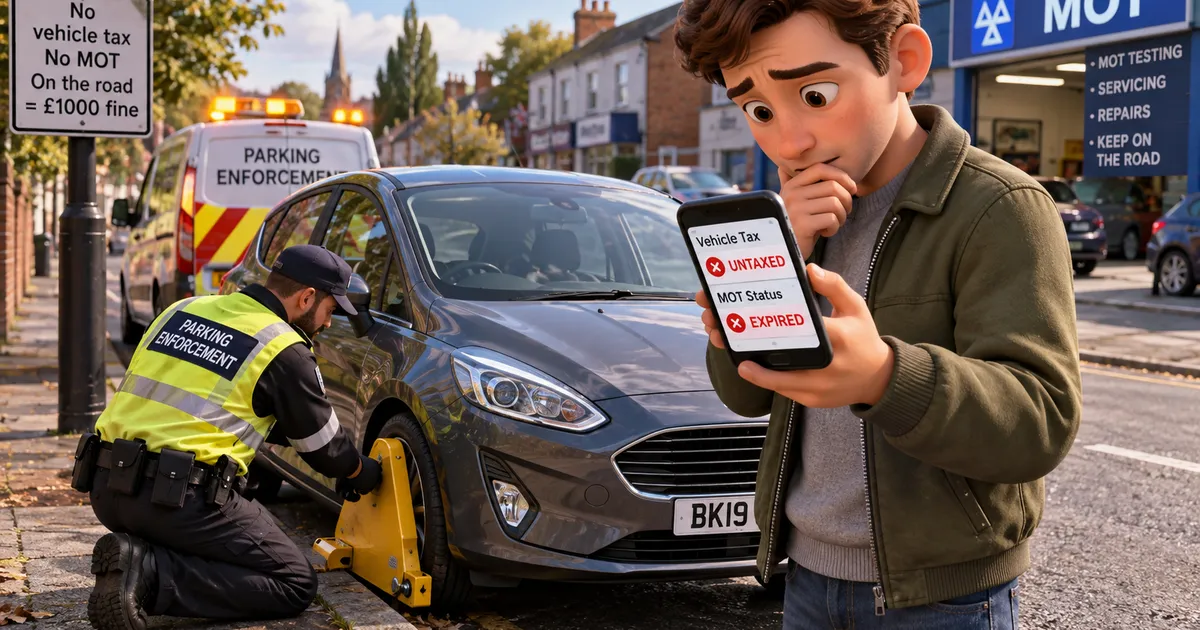
Driving without a valid MOT is an offence. You can be fined up to £1,000 for driving without a valid MOT, and up to £2,500, a driving ban and 3 penalty points for driving with a defect classed as dangerous. Those figures apply to the MOT offence itself; other motoring offences carry their own penalties.
The safer approach is to check the expiry date before it passes, book within the month-before window where possible, and deal with any dangerous or major defect before driving again. More detail on the consequences of ignoring the rules is covered in driving without a valid MOT.
Frequently Asked Questions
Ready to Check a Vehicle?
Get instant access to MOT history, tax status, and comprehensive vehicle information
Check a Vehicle Now