Private Number Plate Rules UK: What Is and Is Not Legal
What is a private (personalised) number plate in the UK?
A private number plate, often called a personalised number plate, is a vehicle registration number bought separately from a vehicle. It is usually purchased from DVLA or from an approved dealer. What the buyer acquires is the right to use the number, not ownership of the physical plate itself. The plate is simply the piece of material on which the registration is displayed.
Once a number has been bought, the holder can assign it to a vehicle, keep it on retention while it is not in use, or sell it on to someone else. Because the registration is a right rather than a physical object, it can move between vehicles and between keepers over time, provided the correct paperwork is in place. Anyone considering a purchase can run a private plate check to see current registration details recorded against a car. Understanding the private number plate rules UK law sets out is essential before assigning or displaying one.
Legal display requirements: what every number plate must show
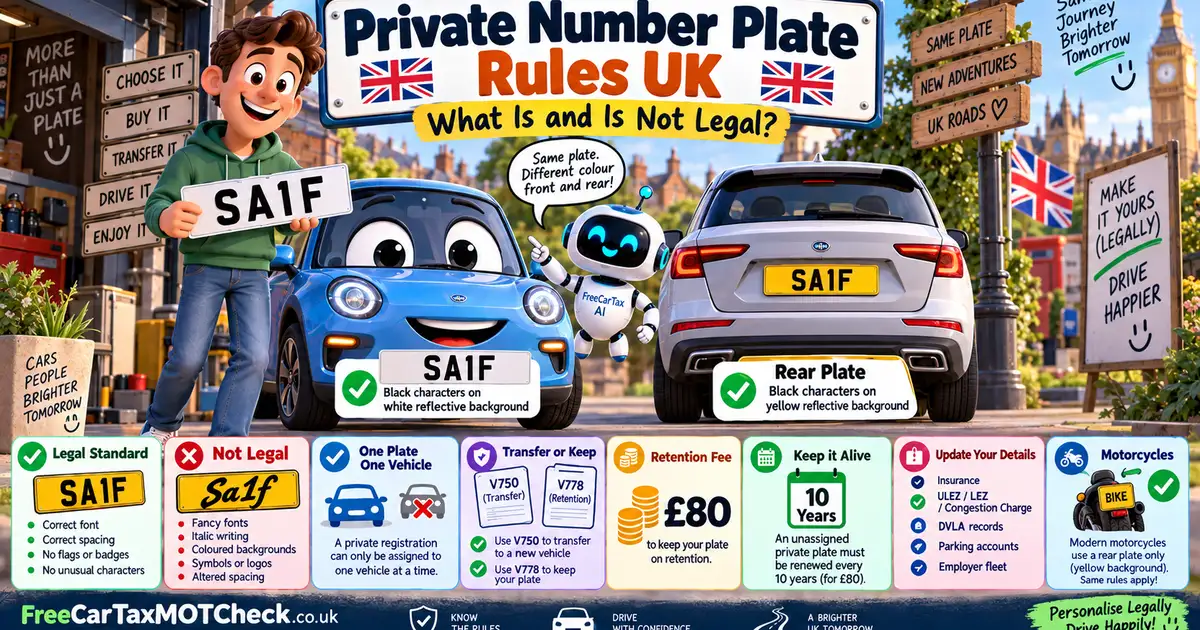
The rules for displaying a number plate apply to all vehicles, whether the registration is standard or personalised. The front plate must show black characters on a white reflective background. The rear plate must show black characters on a yellow reflective background. No background pattern is permitted on either plate, and the characters must not be removable or reflective.
Plates fitted after 1 September 2021 must be marked to British Standard BS AU 145e, and the characters must be a single shade of black. Plates must also be marked to show who supplied them, and that supplier must be registered. Raised 3D characters are permitted, and a green flash is allowed on zero-emission vehicles.
The font, character height, spacing and size are all set by law, as detailed in DVLA guidance INF104. A plate cannot use a decorative or italic font simply because the combination still looks readable. Displaying a plate that does not meet the legal standards can lead to a fine of up to £1,000. These are the core number plate rules UK drivers need to know, and they form the basis of the personalised number plate rules that apply to every private registration before fitting anything new.
Motorcycles: different plate rules
Motorcycles and motor tricycles follow separate display rules. If the vehicle was registered on or after 1 September 2001, it needs a rear plate only, and no front plate is required. If it was registered before that date, it may also display a front plate, but doing so is optional rather than compulsory.
Motorcycle and motor tricycle plate numbers should be displayed on two lines. Owners who are unsure how their machine is recorded can run a DVLA check by registration number to confirm the details held on file. For a wider look at how two-wheeled vehicles are treated, see how motorcycle tax and MOT differ from cars.
The one-vehicle rule and how to transfer a private plate
A private number can only be legally assigned to one vehicle at a time. To move it to a different vehicle, the number must first be taken off the current vehicle through a retention, and then assigned to the new one. This is the standard process for how to transfer a private number plate UK owners use most often.
To assign a number, a valid V750 Certificate of Entitlement or a V778 Retention Document is needed. Assignment can be done online or by post, and when it is made from a valid V750 or V778 it is usually free, because the assignment fee is included in the original purchase price or transfer fee. The vehicle must be registered with DVLA in the UK and be able to move under its own power.
When a vehicle's registration number changes, the insurer must be told, and any congestion charge, LEZ, ULEZ, CAZ or Dart Charge accounts that use the registration must be updated. Failing to update these accounts may result in a penalty charge. Further background is available in this guide to DVLA number plate changes.
Keeping a private plate you are not using: retention
Taking a private number off a vehicle is known as private number plate retention. In the UK it costs £80 and can be done online or by post using form V317. After removal, a V778 Retention Document is issued, which proves the holder still has the right to use the number.
A question many holders ask is: does a private number plate expire? The plate itself does not, but the right to use an unassigned number must be renewed every 10 years, before the V778 document expires. If it is not renewed, the right to use the number is lost. A number starting with "Q" or "QNI" cannot be retained.
Eligibility rules apply. The vehicle must have been taxed or had a SORN in place continuously for the past five years, and it must currently be taxed or have SORN. If a vehicle has been on SORN for more than five years, it must also have a current MOT certificate before the number can be taken off. Anyone checking a car's history first may find it useful to review registered keeper records.
Frequently asked questions
How much does it cost to put a private plate on a car?
Assigning a number from a valid V750 or V778 is usually free, because the assignment fee is included in the original purchase price or transfer fee. Taking a number off a vehicle costs £80.
How long does a private plate certificate last?
The right to use an unassigned number must be renewed every 10 years. Renewal must be completed before the V778 document expires, or the right to use the number is lost.
Can I put a private plate on someone else's car?
The number can only be assigned to one vehicle at a time, and the vehicle must be registered with DVLA in the UK and able to move under its own power. The holder of the V750 or V778 carries out the assignment.
Do I need an MOT to transfer a private plate?
An MOT is not normally required, but if a vehicle has been on SORN for more than five years it must also have a current MOT certificate before the number can be taken off. Driving without valid documents carries its own risks, as set out in penalties for driving without valid documents.
Do personalised number plates affect car insurance?
Changing a vehicle's registration number does not change the cover itself, but the insurer must be told about the change. The same applies to congestion charge, LEZ, ULEZ, CAZ and Dart Charge accounts, which must be updated to avoid a penalty charge.
Frequently Asked Questions
Ready to Check a Vehicle?
Get instant access to MOT history, tax status, and comprehensive vehicle information
Check a Vehicle Now

