Should You Buy a Cat S or Cat N Car?
Cat N car meaning: what Cat N means
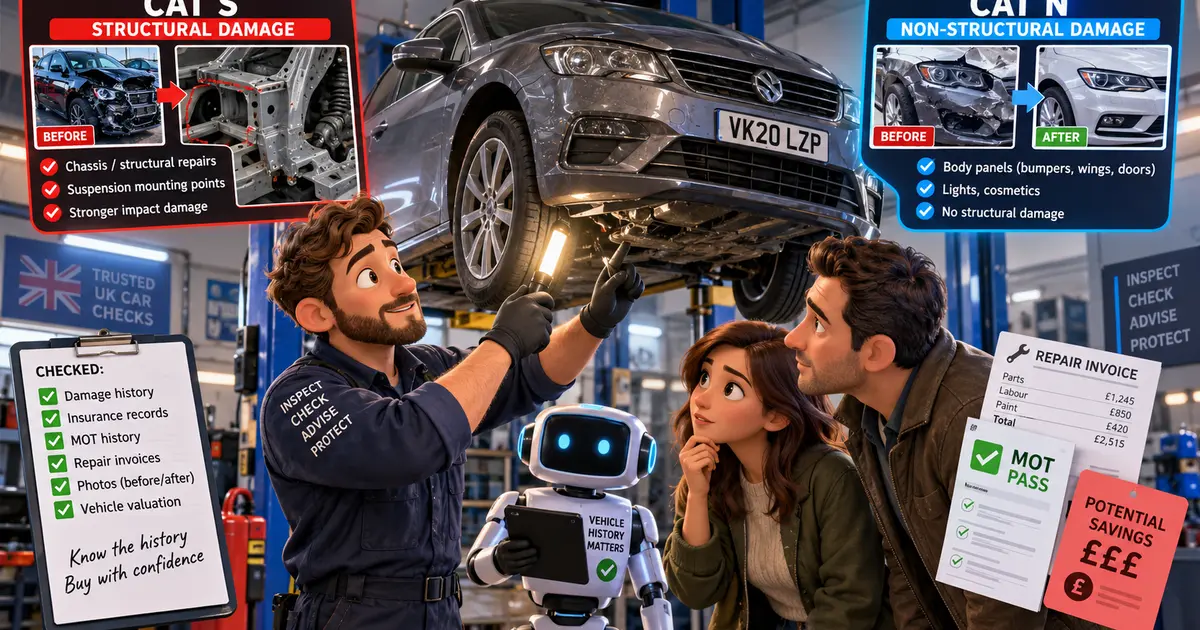
A Cat N car is a vehicle that has been written off by an insurer after an accident where the cost of repair was judged uneconomical compared with the car's value. The "N" stands for non-structural, meaning the damage was confined to body panels, interior fittings, electrical systems or other components that do not form the structural frame of the car. So when asking what is a Cat N car, the answer is a car with a recorded accident history but no damage to the chassis or load-bearing structure. The category was introduced in October 2017, when Cat N replaced the old Cat D classification, and Cat S replaced Cat C. If you are searching for what does Cat N mean on a car, the key point is that the write-off marker stays on the vehicle's record permanently, even after a full repair. Understanding cat N car meaning UK buyers rely on matters because the marker affects value and insurance, and it will appear on a paid history check even though it does not show on the free DVLA vehicle enquiry.
Cat N vs Cat S: the key difference
The distinction between Cat S and Cat N comes down to structure. A Cat S car has sustained structural damage to the chassis, crumple zones or load-bearing frame, and it must be repaired to a roadworthy standard and re-inspected before it can legally return to the road. A Cat N car has no structural damage, so no re-inspection is required by law. This is why Cat N is generally considered the lesser write-off of the two: the damage is cosmetic or mechanical rather than fundamental to the car's strength and crash protection. When comparing cat N vs Cat S, buyers should remember that both categories replaced older classifications after October 2017, and both leave a permanent marker on the car's history. The difference between Cat S and Cat N is not about how the car looks after repair, but about what was damaged in the original accident.
Should you buy a Cat N car?
Whether a Cat N car is worth buying depends almost entirely on the quality of the repair and the price. The ABI recommends that the repair has been completed properly before purchase, so the buyer's main task is to verify that work. Ask for photographs of the damage before repair, invoices from the bodyshop, and any parts receipts. A full service history and a clear record of the repair give confidence that the car has been maintained since. An independent engineer's inspection is strongly advised, particularly for a car with no documented repair evidence, because it can reveal poor paintwork, misaligned panels or hidden faults. On price, Cat N cars typically sell at a significant discount compared with unaffected equivalents, though the exact figure varies by car, damage severity and repair quality. If the discount is small, buying a Cat N car rarely makes sense, since the write-off marker will follow the car and reduce its value at resale.
Insurance for a Cat N car
Insuring a Cat N car is possible, and most major insurers will cover them, but the terms are usually less favourable than for an unaffected vehicle. Premiums are typically higher, and if the car is written off again in the future it will be valued at less than an equivalent car without a marker. When taking out cover, the write-off status must be declared honestly; failing to do so risks a rejected claim or a cancelled policy. It is worth shopping around, because insurers treat Cat N cars differently and quotes can vary widely. A outstanding finance check is also sensible before insuring any used car, as an unresolved finance agreement can affect ownership.
MOT and selling a Cat N car
A Cat N car does not legally need a new MOT or a re-inspection before returning to the road, unlike a Cat S car. The write-off marker, however, remains permanently on the car's history and will show in any paid vehicle history check, which affects resale value. When selling a Cat N car privately, expect buyers to ask for evidence that the repair was done properly, and be prepared to provide photographs, invoices and receipts. A free car check can confirm basic vehicle details, while a used car valuation helps set a realistic asking price. Buyers should also consider a registered keeper check to confirm the seller's identity and ownership.
The UK government provides guidance on insurance write-off categories, explaining what each category means and how insurers decide on total losses.
Frequently Asked Questions
What does Cat N mean on a car?
A Cat N car is a vehicle written off by an insurer after an accident where the cost of repair was judged uneconomical compared with the car's value. The N stands for non-structural, meaning damage was confined to body panels, interior fittings, electrical systems or other components that do not form the structural frame. The category was introduced in October 2017, replacing the old Cat D classification.
What is the difference between Cat N and Cat S?
A Cat S car has sustained structural damage to the chassis, crumple zones or load-bearing frame, and must be repaired to a roadworthy standard and re-inspected before it can legally return to the road. A Cat N car has no structural damage, so no re-inspection is required by law. Cat N is generally considered the lesser write-off of the two.
Should you buy a Cat S or Cat N car?
Whether a Cat N car is worth buying depends almost entirely on the quality of the repair and the price. Cat S cars have structural damage and require re-inspection before returning to the road. For either category, the ABI recommends the repair has been completed properly before purchase, and an independent engineer's inspection is strongly advised, particularly where there is no documented repair evidence.
Should you buy a Cat S or Cat N car if the discount is small?
If the discount is small, buying a Cat N car rarely makes sense, since the write-off marker will follow the car and reduce its value at resale. Cat N cars typically sell at a significant discount compared with unaffected equivalents, though the exact figure varies by car, damage severity and repair quality.
Does a Cat N marker stay on the car permanently?
Yes. The write-off marker stays on the vehicle's record permanently, even after a full repair. It will appear on a paid history check, although it does not show on the free DVLA vehicle enquiry. This is why the marker affects value and insurance.
What evidence should you ask for when buying a Cat N car?
Ask for photographs of the damage before repair, invoices from the bodyshop, and any parts receipts. A full service history and a clear record of the repair give confidence that the car has been maintained since. An independent engineer's inspection is strongly advised, particularly for a car with no documented repair evidence, because it can reveal poor paintwork, misaligned panels or hidden faults.
Can you insure a Cat N car?
Insuring a Cat N car is possible, and most major insurers will cover one. The write-off marker affects insurance, which is one reason the cat N car meaning UK buyers rely on matters. The marker appears on a paid history check even though it does not show on the free DVLA vehicle enquiry.
Ready to Check a Vehicle?
Get instant access to MOT history, tax status, and comprehensive vehicle information
Check a Vehicle Now