How Much Is My Car Worth? Understanding UK Car Valuations
Free ways to find out how much your car is worth
There is no single official government source for used car valuations in the UK. The DVLA free check confirms vehicle details such as make, model, colour and tax status, but it does not show value. Anyone asking how much is my car worth should use an established free valuation service instead. Autotrader, the largest UK used car marketplace, gives a market-based estimate from live listings and sold price comparisons. Parkers, a long-established guide, provides guide prices by model and derivative. The AA offers a free valuation tool built on similar market data. We Buy Any Car gives an instant offer, which is a firm buying price rather than a market estimate. To get a realistic answer to how much is my car worth free, enter the registration and mileage accurately on more than one site and compare the results. If you want to know what is my car worth UK wide, the spread between the highest and lowest figure is useful in itself. A car valuation free UK tool is a starting point, not a final price, so treat each result as an estimate.
Factors that affect your car's value
Several factors decide what affects car value UK sellers and buyers see in practice. Make, model and derivative set the baseline, and age and mileage adjust it from there. Service history and MOT status matter because a fully stamped book and a clean MOT record suggest the car has been maintained. Accident history and write-off markers have a large effect: a Cat N or Cat S record significantly reduces value, and buyers should check this before agreeing a price. The number of previous keepers also counts, since fewer owners usually means a stronger price. Colour and specification can help or hinder, as popular colours and desirable extras sell more easily. Anyone asking how much is my car worth with high mileage should expect a lower figure than the guide price for an average-mileage example. If you are wondering why is my car worth less than expected, the answer is often a combination of these car value factors rather than one single issue.
Trade-in, private sale and retail
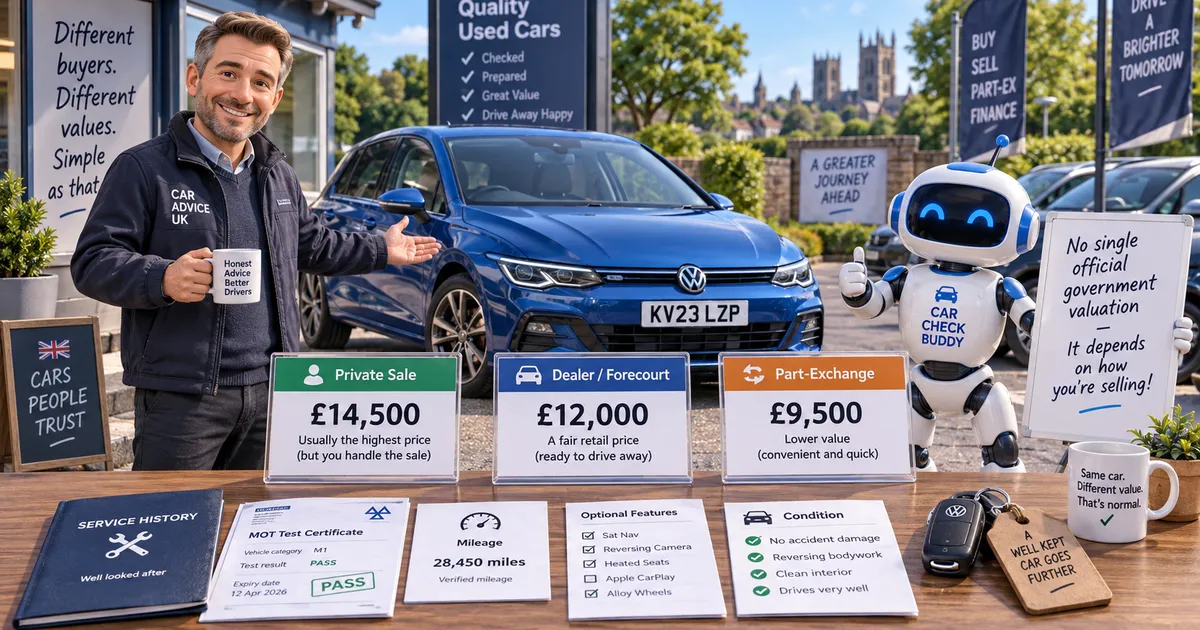
There are usually three prices for the same car: retail, trade and private sale. Retail is the forecourt price a dealer asks, trade-in is what a dealer offers in part exchange, and private sale sits between the two. Trade-in value is typically lower than private sale value, because the dealer needs margin to cover preparation, warranty and resale risk. Private sale values are themselves typically lower than forecourt retail prices. If you are asking how much is my car worth part exchange, expect the lowest of the three figures, but weigh that against the convenience of avoiding viewings. How much is my car worth trade in depends on the dealer, the car's condition and how keen they are to close a deal. How much is my car worth selling privately is usually more, but you take on advertising, viewings, test drives and payment risk. When comparing private sale vs trade in value UK sellers should subtract any costs of selling privately before deciding. The same logic applies in reverse for buyers weighing car part exchange vs private sale.
Using a free valuation before buying
A car valuation before buying used car is essential, because the asking price should be checked against market rates rather than accepted at face value. There is no how much is my car worth UK gov service, so buyers should use the same free tools sellers use. If you want to know how much is my car worth on Autotrader, enter the exact model, year and mileage to see comparable listings. How much is my car worth Autotrader UK results give a useful range, and a seller asking well above that range needs to justify it with condition, history or specification. Compare the seller's price to the trade and private sale figures as well, since a private seller asking retail money is unusual. Before agreeing a price, run a free car check to confirm the vehicle's identity and history, then use the valuation range to negotiate from evidence rather than guesswork.
Outstanding finance and write-offs
Outstanding finance reduces a vehicle's effective value to a buyer, because the finance must be settled before the car can be sold with clear title. Anyone asking how much is my car worth with outstanding finance should understand that the debt follows the car, not the seller, so an unsettled agreement can leave a buyer out of pocket. A car valuation outstanding finance UK buyers rely on should always be paired with an outstanding finance check before money changes hands. Write-off markers cut value just as sharply. How much is my car worth if cat N is a common question, and the answer is that a Cat N record reduces value because the car has been declared a write-off, even where damage was non-structural. How much is my car worth if written off depends on the category, and Cat S cars, which have suffered structural damage, are worth less again. For more detail on Cat N car value and what the markers mean, check the category before you buy or sell. It is also worth knowing how to check if a car has been scrapped, since a scrapped marker removes any road value at all.
Before valuing a car, confirm its specifications are accurate. The free DVLA vehicle enquiry service lets you check official registered details such as engine size, fuel type and year of manufacture.
Frequently Asked Questions
Is there an official government source for how much my car is worth? Understanding UK car valuations
No. There is no single official government source for used car valuations in the UK. The DVLA free check confirms vehicle details such as make, model, colour and tax status, but it does not show value. Anyone asking how much is my car worth should use an established free valuation service instead.
Which free valuation services can I use to find out how much my car is worth? Understanding UK car valuations
Autotrader, the largest UK used car marketplace, gives a market-based estimate from live listings and sold price comparisons. Parkers, a long-established guide, provides guide prices by model and derivative. The AA offers a free valuation tool built on similar market data. We Buy Any Car gives an instant offer, which is a firm buying price rather than a market estimate.
How can I get a realistic free car valuation?
Enter the registration and mileage accurately on more than one site and compare the results. The spread between the highest and lowest figure is useful in itself. A car valuation free UK tool is a starting point, not a final price, so treat each result as an estimate.
What factors affect my car's value?
Make, model and derivative set the baseline, and age and mileage adjust it from there. Service history and MOT status matter because a fully stamped book and a clean MOT record suggest the car has been maintained. Accident history and write-off markers have a large effect, as a Cat N or Cat S record significantly reduces value.
Why is my car worth less than expected?
The answer is often a combination of car value factors rather than one single issue. The number of previous keepers also counts, since fewer owners usually means a stronger price. Colour and specification can help or hinder, as popular colours and desirable extras sell more easily.
How much is my car worth with high mileage?
Anyone asking how much is my car worth with high mileage should expect a lower figure than the guide price for an average-mileage example. Age and mileage adjust the baseline set by make, model and derivative.
What is the difference between trade-in, private sale and retail values?
There are usually three prices for the same car: retail, trade and private sale. Retail is the forecourt price a dealer asks, trade-in is what a dealer offers in part exchange, and private sale sits between the two. Trade-in value is typically lower than private sale value, because the dealer needs margin to cover preparation, warranty and resale risk.
Ready to Check a Vehicle?
Get instant access to MOT history, tax status, and comprehensive vehicle information
Check a Vehicle Now