How to Check If a Car Has Been Stolen Before You Buy It
There is no single free official "not stolen" lookup
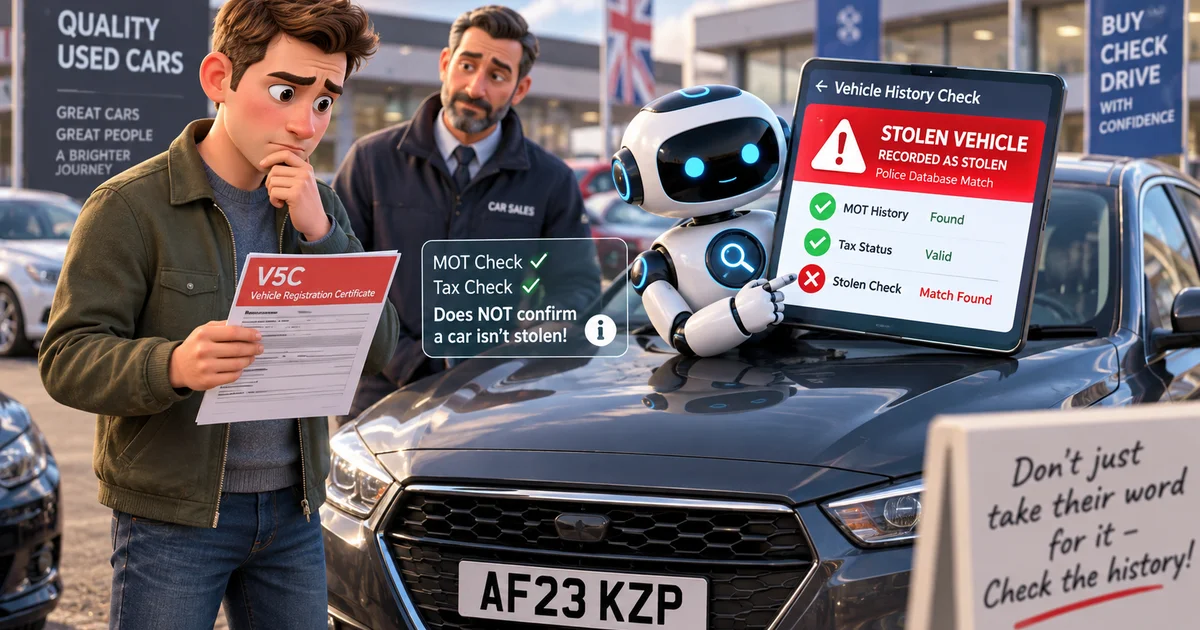
There are several ways to check if a car has been stolen before handing over your money. Buyers often assume that one free government search will confirm a car is not stolen. That search does not exist. The free DVLA vehicle enquiry data used on this site covers tax status, MOT status, make, colour and year of first registration. It is not a stolen-vehicle database and it carries no theft marker, so a clean result here does not prove the car has a lawful history.
What the free data does is confirm that the basic facts about a vehicle are consistent. It cannot tell you who has a claim on it, whether money is owed against it, or whether it has been reported stolen. Treat it as a starting point, not a guarantee. A DVLA check of this kind is useful for spotting mismatches early, before you travel to view a car.
What GOV.UK tells buyers to check
GOV.UK's guidance for used-car buyers includes several checks to carry out before parting with money. First, check that the details you have been given match DVLA's information: make, model, colour and year. If a seller describes a 2018 car and DVLA records a different year or colour, stop and ask why.
Second, check the MOT status and MOT history. Gaps in MOT history, repeated advisories or a long period off the road are worth questioning. Third, check whether the vehicle has been recalled for safety issues. A recall is not proof of theft, but an outstanding recall means a safety fault has not been fixed. Our guide to a safety recall check explains how to look this up.
Checking the V5C registration certificate in person
Ask to see the V5C log book before you discuss price. The document should carry a 'DVL' watermark. Check that the keeper's name and address on the V5C match the person selling the car and the place you are viewing it.
GOV.UK also publishes ranges of stolen blank V5C serial numbers. At the time of writing these are BG8229501 to BG9999030 and BI2305501 to BI2800000. If the serial number on the document falls inside either range, the V5C might be stolen, and the buyer should contact the police once it is safe to do so. These ranges can change, so confirm the current list on GOV.UK's 'Check a used vehicle you're buying' page before you rely on it.
While you are with the car, compare the VIN plate and the VIN stamped or etched on the vehicle against the VIN printed on the V5C. Our VIN check page explains what a vehicle identification number can tell you.
Red flags at the viewing
Some warning signs have nothing to do with databases and everything to do with how the sale is being handled. Be cautious if any of the following apply:
- The seller is reluctant to show the V5C, or says it is elsewhere.
- The keeper name or address on the V5C does not match the seller.
- The price is far below what the car should cost.
- The seller wants cash only, or wants to meet somewhere other than the address on the V5C.
- The VIN on the car does not match the VIN on the V5C.
Any one of these on its own may have an innocent explanation. Several together are a reason to walk away.
When a paid history check is worth it
Paid vehicle history checks commonly include a stolen-vehicle check against police records, alongside other finance and insurance data. Coverage varies between providers, so read what a check actually covers before buying it. A paid check is most useful when the car is expensive, when you cannot view it in person, or when something in the paperwork or the seller's behaviour does not add up. It supplements the free checks and the in-person inspection; it does not replace them. A stolen vehicle check is the type of search buyers usually have in mind here.
If your own vehicle is stolen, report it to the police. The police inform DVLA about the theft and about the vehicle being found.
Always verify a vehicle's official registration details using the free DVLA vehicle enquiry service — mismatched details are a strong indicator of a cloned or stolen vehicle.
Frequently Asked Questions
Is there a free official check that confirms a car is not stolen?
No. There is no single free official "not stolen" lookup. The free DVLA vehicle enquiry data covers tax status, MOT status, make, colour and year of first registration. It is not a stolen-vehicle database and carries no theft marker, so a clean result does not prove the car has a lawful history.
What does the free DVLA vehicle enquiry actually tell me?
It confirms that the basic facts about a vehicle are consistent. It cannot tell you who has a claim on it, whether money is owed against it, or whether it has been reported stolen. Treat it as a starting point, not a guarantee, and use it to spot mismatches before you travel to view a car.
How do I check if a car has been stolen before you buy it using GOV.UK guidance?
GOV.UK advises checking that the details you were given match DVLA's information: make, model, colour and year. Also check MOT status and history, and whether the vehicle has been recalled for safety issues. An outstanding recall means a safety fault has not been fixed, though it is not proof of theft.
What should I look for on the V5C registration certificate?
Ask to see the V5C before discussing price. It should carry a 'DVL' watermark. Check that the keeper's name and address match the person selling the car and the viewing location. GOV.UK publishes ranges of stolen blank V5C serial numbers, so confirm the current list on GOV.UK before relying on it.
How can I check if a car has been stolen before you buy it when viewing in person?
Compare the VIN plate and the VIN stamped or etched on the vehicle against the VIN printed on the V5C. If the VIN on the car does not match the VIN on the V5C, be cautious. This is one of several red flags to look for at the viewing.
What are the red flags that suggest a car sale may not be legitimate?
Be cautious if the seller is reluctant to show the V5C or says it is elsewhere; the keeper name or address does not match the seller; the price is far below what the car should cost; the seller wants cash only or to meet somewhere other than the V5C address; or the VIN on the car does not match the V5C.
What should I do if the V5C serial number falls within a published stolen range?
GOV.UK publishes ranges of stolen blank V5C serial numbers. If the serial number on the document falls inside either range, the V5C might be stolen, and the buyer should contact the police once it is safe to do so. These ranges can change, so confirm the current list on GOV.UK.
Ready to Check a Vehicle?
Get instant access to MOT history, tax status, and comprehensive vehicle information
Check a Vehicle Now