What Insurance Group Is My Car? How Group Ratings Actually Work
How to check your car's insurance group by reg
To find out what insurance group is my car, the quickest route is a lookup that works from the registration number. Several comparison sites and car data providers offer a check insurance group by reg service. These map the registration to the car's make, model and derivative, then return the group for that specification. A car insurance group check uk search usually brings up one of these alongside the official source. The Thatcham insurance group lookup is the official one, run by Thatcham Research, the Motor Insurance Repair Research Centre. It can be searched by make, model and derivative at thatcham.org or through their official lookup tool. A result typically shows the insurance group on the 1 to 50 scale, plus the make, model and derivative it matched to. Confirm the derivative matches your car exactly, because small trim or engine differences can sit in different groups. For a car you do not yet own, a free car check confirms the basic details before you run the group lookup.
What insurance groups mean
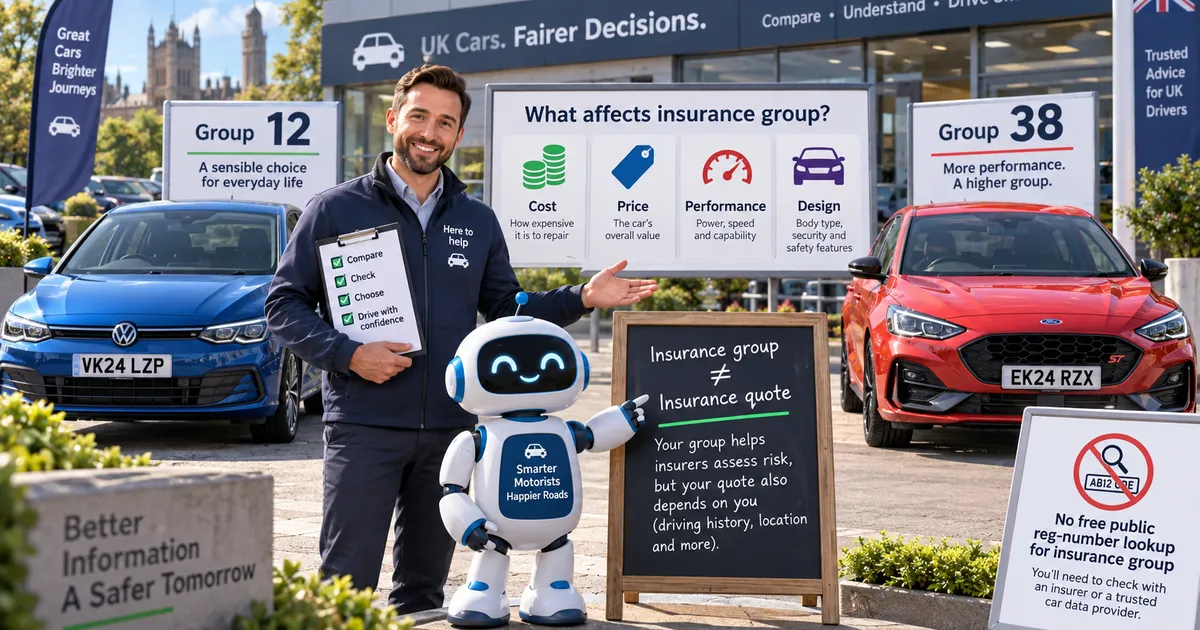
Every new car sold in the UK is assigned an insurance group from 1 to 50 by Thatcham Research. Group 1 is the cheapest to insure and group 50 the most expensive. So what does insurance group mean in practice? It is a standardised rating of the risk and cost an insurer takes on by covering that vehicle. When people ask what insurance group is my car in, or search what insurance group is my car uk, they are placing their car on that 1 to 50 scale. Car insurance groups explained simply: a low number signals a car that is cheap to repair, modest in performance and well protected against theft, while a high number signals the opposite. That is what car insurance group 1 to 50 means, a single scale that lets buyers compare vehicles before approaching an insurer. What is insurance group on a car, then, is not a quote, but a starting point insurers use when pricing cover.
What determines a car's insurance group
The group is based on several factors. Repair cost and parts availability matter, because a car with expensive or hard-to-source parts costs more to put right after a claim. Performance counts too, including acceleration and top speed. Safety features and new car value both feed into the rating, as do security devices such as the alarm, immobiliser and Thatcham category. Those are the criteria behind how is insurance group determined. They also explain why is my car in a high insurance group: a fast, costly model with expensive panels and complex electronics sits higher than a simple, cheap-to-fix hatchback. The same criteria explain how a car can change car insurance group. Insurance groups can change when a car is substantially modified, and modified vehicles may need to be reported to an insurer and can be re-grouped. If you are weighing up a modified or previously damaged car, read about Cat N cars and insurance first.
Insurance group vs your actual premium
The insurance group is not the only factor determining your premium. Your own driving record, age, address, annual mileage and other factors all affect the price. Two drivers insuring the same group 1 car can have very different premiums. That is the key point when people ask does insurance group affect premium, or how much does insurance group affect price. The group shapes the insurer's view of the vehicle, but the driver shapes the rest. A young driver with a clean licence in a low-crime area may pay less than an older driver with points and prior claims, even in the same car. High insurance group cars generally cost more to cover, but the gap between two drivers can be wider than the gap between two groups. A free lookup, such as what insurance group is my car by reg free tools, gives you the vehicle side of the picture. Before buying, run an outstanding finance check so there are no surprises beyond the premium.
Cheapest insurance groups for young drivers and buying advice
For new drivers, the lowest insurance group cars are the sensible starting point. Cars in groups 1 to 5 are the cheapest to insure, which is why they are often called the best insurance group for young drivers. Group 1 insurance cars uk buyers look for tend to be small, modestly powered and cheap to repair, keeping both the group and the premium down. If you are shopping for cheapest insurance group cars uk dealers stock, run the group lookup before you buy rather than after. Check the exact derivative, confirm the group, then get quotes in your own name so you see the real price. If the car turns out to be an import, the picture can change, so read up on grey import insurance issues first. Checking the group before purchase takes minutes and can save a great deal over the life of the car.
For official vehicle details, including engine size and fuel type used to calculate your insurance group, you can use the free DVLA vehicle enquiry service.
Frequently Asked Questions
What insurance group is my car? How group ratings actually work?
Every new car sold in the UK is assigned an insurance group from 1 to 50 by Thatcham Research. Group 1 is the cheapest to insure and group 50 the most expensive. The group is a standardised rating of the risk and cost an insurer takes on by covering that vehicle, not a quote. Insurers use it as a starting point when pricing cover.
How can I check my car's insurance group by registration?
The quickest route is a lookup that works from the registration number. Several comparison sites and car data providers offer a check insurance group by reg service. These map the registration to the car's make, model and derivative, then return the group for that specification. A car insurance group check uk search usually brings up one of these alongside the official source.
What is the official insurance group lookup?
The Thatcham insurance group lookup is the official one, run by Thatcham Research, the Motor Insurance Repair Research Centre. It can be searched by make, model and derivative at thatcham.org or through their official lookup tool. A result typically shows the insurance group on the 1 to 50 scale, plus the make, model and derivative it matched to.
Why does the derivative need to match my car exactly?
You should confirm the derivative matches your car exactly, because small trim or engine differences can sit in different groups. The lookup maps your registration to a specific make, model and derivative, so an incorrect match could return the wrong group for your vehicle.
What insurance group is my car? How group ratings actually work for a car I do not yet own?
For a car you do not yet own, a free car check confirms the basic details before you run the group lookup. This lets you establish the make, model and derivative so the insurance group result matches the vehicle you are considering.
What determines a car's insurance group?
The group is based on several factors. Repair cost and parts availability matter, because a car with expensive or hard-to-source parts costs more to put right after a claim. Performance counts too, including acceleration and top speed. Safety features and new car value both feed into the rating, as do security devices such as the alarm, immobiliser and Thatcham category.
Can a car's insurance group change?
Insurance groups can change when a car is substantially modified, and modified vehicles may need to be reported to an insurer and can be re-grouped. If you are weighing up a modified or previously damaged car, it is worth reading about Cat N cars and insurance first.
Ready to Check a Vehicle?
Get instant access to MOT history, tax status, and comprehensive vehicle information
Check a Vehicle Now